Foundation Repair SEO vs PPC: Which Channel Earns More Leads in 2026?
Most foundation repair contractors treat SEO and PPC as an either/or decision. That single framing is costing them leads.
The real question in 2026 is not which channel wins outright, but which channel to fund first, how much to allocate, and how to measure both accurately when Google's AI Overviews are reshaping the search results your customers actually see.
Understanding foundation repair SEO vs PPC is the difference between a marketing budget that compounds and one that evaporates.
Key Takeaways
- Local foundation repair SEO realistically takes 6-12 months due to Google Business Profile authority requirements and domain competition
- Metro PPC costs for terms like "foundation crack repair" averaged $35-95 per click in 2026 (WordStream home services benchmark)
- AI Overviews now capture roughly 40% of clicks on informational foundation queries, making transactional and "near me" targeting more critical than ever
- Long-tail terms like "crawl space repair near me" convert at 3x the rate of broad match terms, heavily favoring an SEO content strategy
- A 50/50 hybrid SEO-PPC budget split consistently outperforms single-channel campaigns in competitive home services markets
Table of Contents
- SEO vs PPC for Foundation Repair: Quick Comparison at a Glance
- The Real Cost and Timeline Breakdown
- Building a Hybrid Strategy with AI Attribution and Smarter Spend
- Key Takeaways
- FAQ
SEO vs PPC for Foundation Repair: Quick Comparison at a Glance
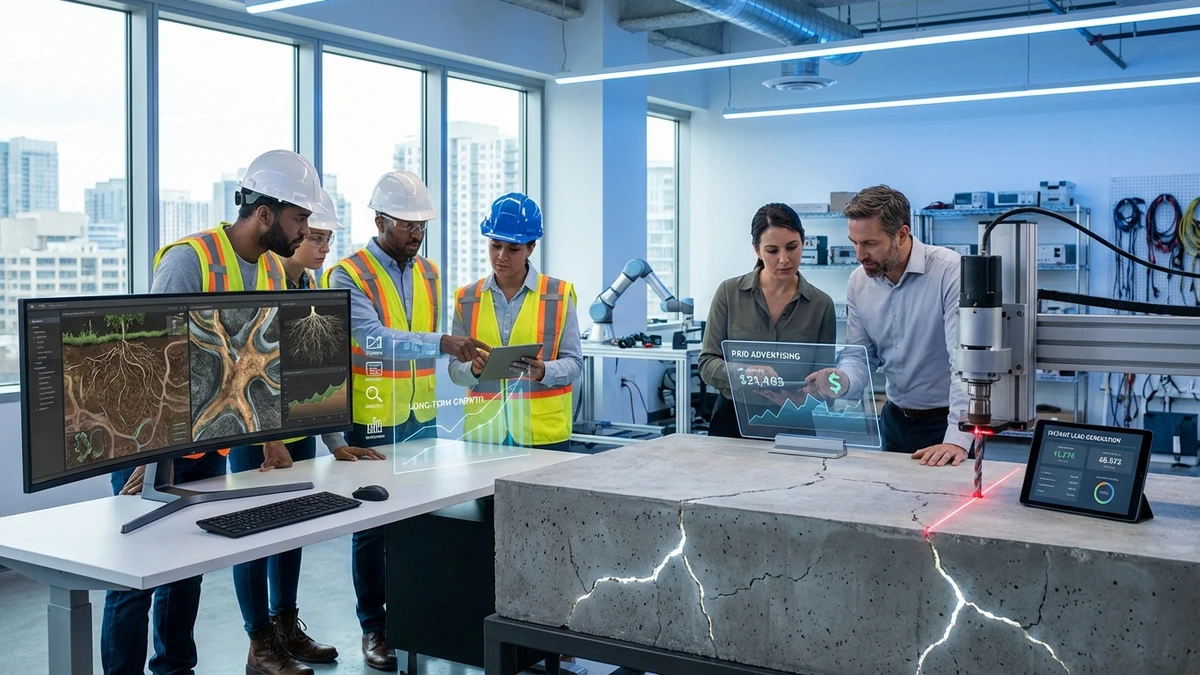
Here is how the three models stack up across the metrics that actually matter for foundation repair contractors in 2026. Whether you are running pay-per-click advertising campaigns or investing in expert SEO optimization services, the numbers tell a clear story.
| Criteria | SEO | PPC | Hybrid Model |
|---|---|---|---|
| Cost Structure | Fixed monthly investment; compounds over time | Pay-per-click; stops when budget pauses | Balanced fixed + variable spend |
| Time to First Lead | 6-12 months (local pack: 60-90 days) | 24-72 hours post-launch | Immediate via PPC; organic builds in parallel |
| Average ROAS | High long-term (3-5x after month 12) | Moderate short-term (2-3x in metro markets) | Highest overall when attribution is tracked correctly |
| Keyword Targeting Depth | Deep; long-tail content drives 3x conversion rates | Broad to exact match; negative keywords essential | Full funnel coverage across intent stages |
| Scalability | Scales organically; content compounds | Scales with budget; no ceiling | Most scalable model for national franchises |
| AI Tool Compatibility | High; AI content tools accelerate blog production | High; Performance Max automates bid optimization | Full compatibility with GA4 multi-channel attribution |
" That shift pushes organic search strategy firmly toward transactional and local intent keywords, where AI Overviews appear far less frequently and organic listings still command strong click-through rates. for transactional terms are seeing the strongest returns in this environment.
The Real Cost and Timeline Breakdown
The claim that foundation repair SEO delivers results "in weeks" is one of the most repeated inaccuracies in home services marketing. Competitive metro markets require 6-12 months to build the domain authority and Google Business Profile signals necessary to rank consistently.
Google Business Profile optimizations, structured citations, and review velocity can produce local pack improvements in 60-90 days, but full organic ranking authority takes considerably longer. sustainably need to plan for that timeline from the start.
On the paid search side, the 2026 cost reality is sharper than most guides acknowledge. Metro CPCs for terms like "foundation crack repair" and "basement waterproofing near me" now average $35-95 per click.
Without a carefully maintained negative keyword list filtering out terms like "DIY," "cost of," and "how to," ad spend bleeds quickly on non-converting traffic. Think of it like running a service truck without checking the fuel gauge: the campaign keeps moving until it suddenly stops.
Pro Tip: Build your negative keyword list before your first campaign goes live, not after. Reviewing search term reports weekly for the first 30 days is the fastest way to protect budget in high-CPC foundation repair markets.
Seasonal patterns create one of the most overlooked paid advertising opportunities in this niche. Q2 and Q3 post-storm and post-flood surges drive sharp demand spikes for foundation assessment and waterproofing services. Aggressive bidding during these windows yields the highest short-term ROAS of any period in the calendar year, making a well-structured pay-per-click advertising campaign essential for capturing that seasonal volume.
For B2B contractors scaling nationally, the winning model combines centralized SEO content hubs targeting broad educational queries at the brand level with hyper-local PPC campaigns per service area.
A national franchise running geo-specific ad groups in Dallas, Atlanta, and Chicago simultaneously, while a central blog builds topical authority, outperforms any single-market strategy at scale. from comparable home services businesses can help calibrate realistic expectations for both channels.
Building a Hybrid Strategy with AI Attribution and Smarter Spend
Here is where the foundation repair SEO vs PPC debate gets genuinely interesting. GA4 multi-channel funnel attribution consistently shows that organic search initiates the customer journey while paid search closes it.

A homeowner searches "signs of foundation settling," reads a blog post, leaves, then converts three days later on a branded PPC ad. Single-channel attribution credits PPC with the conversion.
Multi-channel attribution reveals that SEO earned the first touch, and without GA4's assisted conversion reporting, you would cut the channel that actually started the relationship.
Contractors who run both channels but track them separately consistently undervalue their organic search investment and over-allocate to paid campaigns. The fix is straightforward: set up GA4 multi-channel funnels and review assisted conversions monthly before making any budget decisions. That one habit changes how most contractors interpret their own data.
can further automate reporting and surface attribution insights that manual dashboards miss.
On the AI tools front, two platforms stand out in 2026. Google Performance Max automates bid optimization across Search, Display, and Maps simultaneously, making it particularly effective for foundation contractors who want coverage across multiple placements without managing separate campaigns.
For organic search, AI content tools like Jasper accelerate long-tail blog production, helping contractors build topical authority around terms like "pier and beam repair cost" and "crawl space encapsulation near me" faster than manual content workflows allow.
ensure their site architecture supports both content scaling and technical SEO requirements simultaneously.
A practical budget framework that performs in competitive markets:
- Q1 (January-March): Moderate PPC spend; invest heavily in SEO content and link building during the slower demand period
- Q2-Q3 (April-September): Increase PPC budgets aggressively to capture storm-season demand spikes; maintain SEO publishing cadence
- Q4 (October-December): Pull back PPC to base levels; redirect savings into technical SEO, CMS improvements, and content for the following spring
during Q1 and Q4 keeps brand visibility consistent even when paid search budgets are reduced. Platforms like Facebook and Nextdoor are particularly effective for foundation repair contractors targeting homeowners in specific zip codes.
ensures that traffic from both organic and paid channels has a structured path to conversion rather than landing on a generic homepage.
At Biteabyte, we offer a full suite of digital marketing services including web design, SEO, and SMM, which means campaign data flows into a single reporting layer rather than three disconnected dashboards.
Agencies that manage organic search, paid advertising, and AI-powered analytics under one roof eliminate the attribution gaps that appear when these channels run in separate silos. before your Q2 storm-season window opens.
Key Takeaways
- SEO builds compounding authority over 6-12 months; PPC delivers leads within days but stops the moment budgets pause
- "Foundation repair near me" averages 40,500 monthly searches with local pack results dominating 90% of SERPs
- PPC CPCs range from $35-95 in metro markets for foundation-specific terms (2026 WordStream home services benchmark)
- A 50/50 hybrid SEO-PPC budget split is increasingly the standard for ROAS optimization in competitive home services markets
- Google Performance Max and GA4 multi-channel attribution are the two tools reshaping how foundation contractors measure what is actually working
FAQ
How long does SEO take for a foundation repair company?
Realistically, 6-12 months for competitive local markets. Google Business Profile optimizations, consistent review generation, and structured local citations can produce local pack improvements in 60-90 days, but stable organic rankings for high-volume terms require sustained effort beyond that window.
alongside their SEO campaigns tend to see faster ranking stability because technical issues get resolved before they compound.
What is a realistic PPC budget for foundation repair leads?
Most metro-area contractors need $3,000-8,000 per month minimum to compete effectively given $35-95 CPCs. Smaller or rural markets can start at $1,500 per month with tight geo-targeting and a well-structured negative keyword list to protect spend efficiency. Reviewing our frequently asked questions page covers additional budget benchmarks for home services paid advertising.
Should foundation repair companies use SEO or PPC first?
PPC first if you need leads within 30 days. SEO first if you have a 12-month runway and want a lower cost-per-lead over time. A hybrid approach from day one is optimal if the budget allows, because the channels compound each other's performance when attribution is tracked correctly.
page outlines how both channels can be structured within a single campaign framework.
How does AI change foundation repair digital marketing in 2026?
Google's AI Overviews now capture roughly 40% of informational query clicks, reducing organic traffic for top-of-funnel content. This makes transactional and "near me" keyword targeting more critical than ever for both organic and paid search strategies.
On the campaign management side, Performance Max and smart bidding tools are reducing the manual workload for paid advertising, while AI content platforms are accelerating SEO content production at scale. to automate reporting, content workflows, and bid management from a single platform.
What metrics should foundation repair contractors track for SEO and PPC?
For organic search: track local pack rankings, Google Business Profile views, organic click-through rate, and assisted conversions in GA4. For paid search: monitor cost-per-lead, conversion rate by ad group, impression share, and search term report data weekly.
The most important metric across both channels is assisted conversion data in GA4, which reveals how organic and paid touchpoints interact across the full customer journey rather than crediting only the last click. for a full attribution audit.